Interaction of hydrogen with material
Characterization of hydrogen uptake
In order to know how a material will perform in an hydrogen-containing environment, it is useful to know how much hydrogen is/can be absorbed by the material. The total content of hydrogen in steels can be measured via hot/melt extraction.
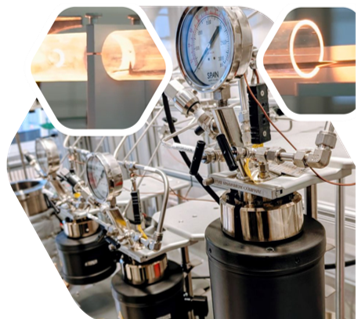
To simulate possible hydrogen uptake, samples can be charged with hydrogen. Two ways of charging can be employed, i.e. by using an electrochemical cell or by use of the autoclave set-ups. The former can be used to simulate hydrogen absorption as a side effect of corrosion or cathodic protection, or to simulate severe conditions. The latter allows to expose the materials to a hydrogen gas environment at high pressures and elevated temperatures. Often, in real life conditions, the materials are exposed to an (elastic) load. These loads may have a pronounced effect on the hydrogen uptake. Therefore, both autoclave charging and electrochemical charging can be combined with a simultaneous load.
More detailed information on the state of the hydrogen in the materials can be obtained by thermal desorption spectroscopy (TDS). TDS allows to gain insight on the trapping of hydrogen at microstructural features and can provide information on the diffusion coefficient in FCC materials.
Permeation testing
The hydrogen diffusion coefficient is an important factor to understand how the material will perform in hydrogen-containing environments. It determines how fast hydrogen will move through the material and, as such, how fast it can segregate at critical spots. The apparent diffusion coefficient can be determined by using our electrochemical permeation set-up employing a Devanathan-Stachurski cell.
In the presence of mechanical load, the diffusion coefficient can be significantly altered. Therefore, it is important to evaluate the diffusion coefficient also in stressed conditions. The SMS research group developed a unique extension to the permeation setup enabling the evaluation of the hydrogen diffusivity within a material under constant tensile load.
HE testing
To evaluate the effect of hydrogen on the mechanical properties of the materials, various mechanical tests can be performed, i.e. slow strain rate testing, 3-point bending, and step load testing. These tests can be performed ex-situ, i.e. after charging the samples with hydrogen in ambient conditions, or in-situ, with simultaneous hydrogen charging.
Afterwards, fractographic analysis with SEM can be performed to evaluate the failure mechanism and identify possible weak spots in the microstructure.
Advanced characterization can be done by using tensile straining of pre-charged specimens inside the SEM chamber. As such, the effect of hydrogen on the straining behaviour can be directly observed, revealing crack initiation sites, strain localization, or early phase transformations.
Other hydrogen inquiries
The Sustainable Materials Science group possesses a ‘SME e-wallet’ (Kmo-portefeuille) profile, which allows entrepreneurs to get financial aid when contracting with us. More information
Is your hydrogen interaction issue or investigation more complex, or do you have further questions regarding our expertise and what we can do for you? contact our experts