Pocket Power: Small-Scale Digestion on the Farm
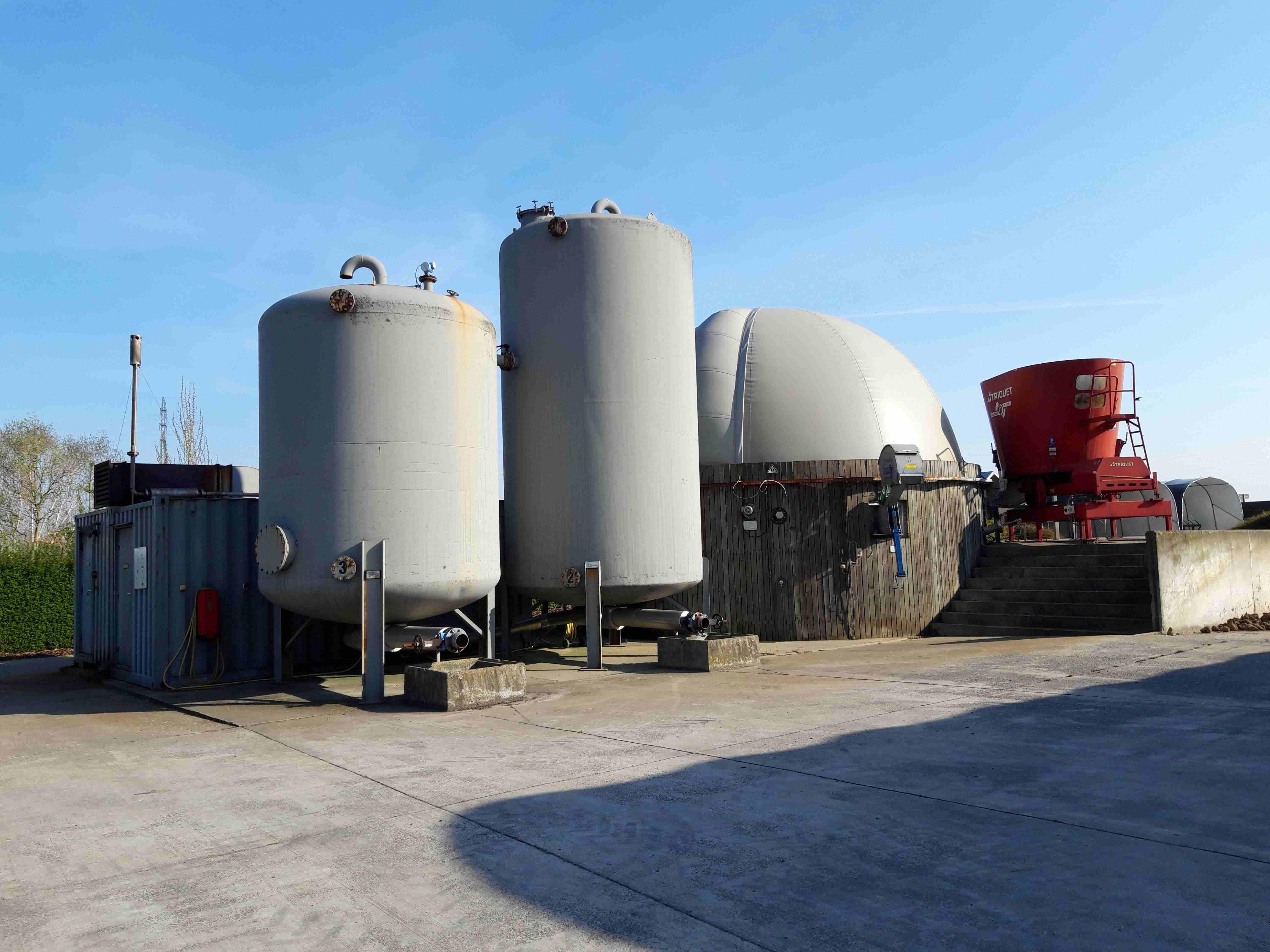
Pocket digestion offers a solution for processing residual streams on farms while providing affordable energy.
At present, this technology is mainly used on dairy farms. The Pocket Power project investigated whether it could also be implemented on pig farms and vegetable holdings, and examined its impact on greenhouse gas emissions.
WHAT IS POCKET DIGESTION?
Small-scale digestion, or pocket digestion, is a technology in which on-farm biomass streams are digested directly at the farm. The digestion process takes place in a large reactor tank in the absence of oxygen (anaerobic) at a temperature of 37–42 °C. During digestion, organic material (e.g. cattle slurry) is converted into biogas. This biogas (mainly methane) is then used as a renewable energy source in a combined heat and power installation (CHP).
Belgian agriculture faces two major challenges today: on the one hand, energy prices continue to rise, and on the other, many residual streams on farms remain underutilized and cause nuisance. Pocket digestion of these residuals can help meet (part of) the farm’s energy demand by producing electricity and heat through CHP.
In addition, small-scale digestion also reduces greenhouse gas emissions from manure storage. In Flanders, 20% of agricultural greenhouse gas emissions originate from manure storage. By transporting fresh manure directly to a digester, these gases can be captured and utilized, thus reducing emissions from storage.
Thanks to its local character and limited scale, a pocket digester also reduces transport needs, minimizes landscape disruption (and thus increases acceptance by neighbors), ensures independence from volatile market prices, and avoids competition for feedstocks.
POCKET DIGESTION IN FLANDERS
Today, pocket digestion in Flanders mainly takes place on dairy farms. But can it also work for pig farmers and vegetable growers who want to valorize their residual streams? What impact does small-scale digestion have on greenhouse gas (GHG) emissions? And how can these be kept as low as possible?
To answer these questions, the ‘Pocket Power’ project was set up — a collaboration between Inagro, Ghent University, Biogas-E, United Experts, Biolectric, and GreenWatt.
GREENHOUSE GASES
The climate impact is very positive: methane emissions from manure storage on a dairy farm can be reduced by up to 70% through digestion of fresh manure.
Furthermore, small-scale digestion can reduce the combined manure- and energy-related greenhouse gas emissions of a standard dairy farm by up to 50%. Such reductions are achievable provided key conditions are met, including a sufficiently long retention time, proper management, and minimal gas losses.
POCKET DIGESTION ON PIG AND VEGETABLE FARMS
There is also good news for Flemish pig farmers: tests with fresh manure mixed with slurry have shown that pig slurry can be digested as a single stream. Economically, the pig sector also shows potential. A sector-wide scan calculated how many farms could profit from small-scale digestion, considering available residual streams, energy consumption profiles, and the expected revenues and costs of digesting on-farm biomass. The result: 44% of Flemish pig farms are eligible for small-scale digestion.
For vegetable residues, the picture is less profitable. From a technical perspective, digestion of these residues is feasible as long as sand can be sufficiently removed. However, significant additional infrastructure is required to chop, wash, or remove sand from the residues, and to provide temporary storage.
Interested in getting started?
Do you have further questions about what is possible, or would you like to get started with small-scale digestion yourself? Contact Nutricycle Flanders at https://nutricycle.vlaanderen/