Anisakidae

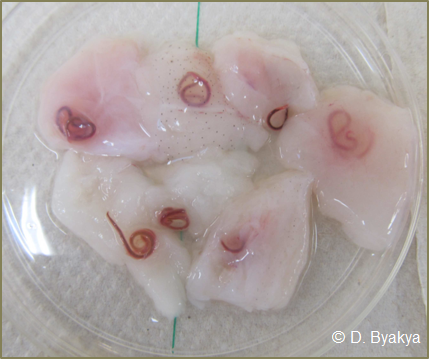
The marine roundworms (nematodes), Anisakis and Pseudoterranova species, have marine mammals and fish eating birds as final hosts, crustaceans as first intermediate host and cephalopods and saltwater fish as second intermediate hosts or paratenic hosts.
When people consume infected raw or undercooked intermediate hosts they can become accidental hosts. This can (not always) cause clinical symptoms going from mild to severe abdominal complaints and allergic reactions. The latter are caused by specific allergenic worm proteins, of which some seem to be freeze and heat resistant (Nieuwenhuizen & Lopata, 2013).
High prevalences of anisakidae have been detected in most commercial fish species (for some fish species close to 100%), with a cosmopolitan distribution (Pozio, 2013). An increased occurrence in fish and in human cases has been observed in the last decades, probably due to an increase in occurrence of marine mammals (final hosts), increase in fish consumption, increase in raw fish consumption (imported traditional dishes), but also due to an increased attention of stakeholders and improved (use of) diagnostic tools.
Besides being a public health problem, the high occurrence of viable worms in fish has led to a high number of customers complaints which in turn has a big economic impact on the fish industry (Pozio, 2013). The sector is obliged to inspect all fish for the presence of these roundworms and remove as many as possible manually. This entails a huge labour cost, and is inefficient. Even when applying these techniques, many fish fillets arrive at the consumer with viable worms, thus not eliminating the public health risk and consumers complaints.
The laboratory of foodborne parasitic zoonoses studies the occurrence of these parasites in Belgium, their impact on the fish industry, and looks into more rapid diagnostics and methods to remove larvae from the fish fillets. Additionally the laboratory studies bacterial and allergic concerns related to these parasites.
Parts of this research is done in collaboration with the Laboratory of Microbiology and the Faculty of Bioscience Engineering, Department of Food Technology, Safety and Health.
- ANISALL: ANISAKIDAE: STUDYING THE HIDDEN ALLERGIC CONCERNS IN FISH, PORK AND CHICKEN MEAT
This project entails a large-scale, quantitative study on both fish meal, and imported and local animal products to determine the risk of exposure to Anisakid allergens for the Belgian consumer. Sufficient proof-off principle has been provided in the past that demonstrates the transmissibility of Anisakid allergenic peptides from fish meal, as a feed component, to aquacultured fish and chicken meat. Additionally, a reliable and rapid detection tool is needed. Existing Anisakid allergen detection methods will be evaluated with the goal of providing recommendations to relevant industries.

Funding: FPS Public Health (FOD Volksgezondheid, Veiligheid van de Voedselketen en Leefmilieu)
- UNRAVELLING THE HEALTH RISKS OF FISHBORNE NEMATODES IN SOUTHERN VIETNAM EMBEDDED IN CAPACITY BUILDING AND STAKEHOLDER ENGAGEMENT
Food safety is a global public health concern whereby the South-East Asia region is impacted the most. Reports on Anisakidae, fishborne parasites, from Vietnam, indicate an alarming potential public health concern. This project aims to contribute to the needed capacity and awareness creation and to build a comprehensive knowledge about the hazards and the risks to consumers, needed for the development of control strategies, thereby supporting governments to substantially reduce disease burden.
Funding: VLIRUOS
Partners: Universiteit Gent (Belgium), Nong Lam University (Vietnam), Can Tho University (Vietnam), National Institute of Malariology – Parasitology – Entomology (Ho Chi Minh City, Vietnam), Research Institute for Agriculture No.2 (Vietnam), University of Medicine and Pharmacy (Ho Chi Minh City, Vietnam), Regional Animal Health Organization No.6 (Vietnam), Institute of Public Health (Ho Chi Minh City, Vietnam.
