Field trials on bean demonstrate bionematicidal activity of cucumber extracts
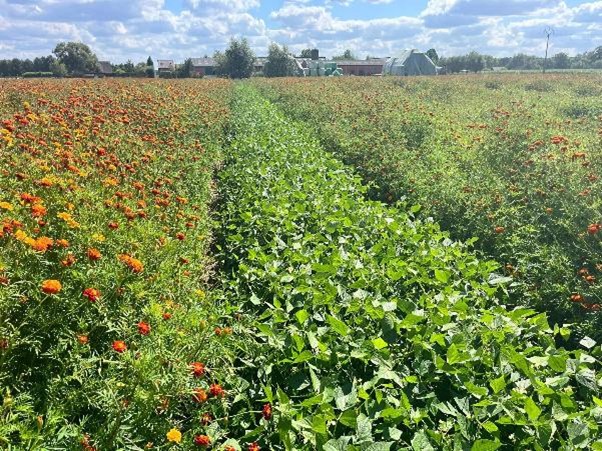
(22-12-2025) Field trials show cucumber leaf extracts can improve plant growth and reduce nematodes, offering a promising bio-based alternative from crop residues.
Within the framework of the VLAIO LA trajectory Zero Waste, Ghent University under the supervision of Professor Tina Kyndt and in collaboration with Proefstation Sint-Katelijne-Waver, investigated the activity of different plant extracts against the root-lesion nematode Pratylenchus penetrans. For this study, cucumber and bell pepper extracts were prepared from leaves collected at the end of the crop cycle.
Field trials were conducted on bean plants. The plant extracts were applied in furrow on the moment of sowing, followed by three foliar applications on 14-day old plants, repeated at 10-day intervals. A commercial bionematicide was included as positive benchmark, alongside an untreated negative control.
Five weeks after sowing, bean plants were visually assessed for vegetative growth. Plants treated with the commercial benchmark and with cucumber extract showed improved vegetative growth compared to untreated plants. To further evaluate nematode infestation, quantitative PCR (qPCR) analysis was performed on root samples. qPCR analysis indicated a reduced nematode presence in plant roots treated with cucumber extract compared to the commercial benchmark and the negative control. Although the differences were not statistically significant, the results of the qPCR demonstrated the potential of cucumber extracts as bionematicide.
The use of cucumber extract as a bionematicide is protected under patent application WO2021009164A1, providing a solid basis for further development. Ghent University is currently seeking an industrial partner to further develop and commercialise this cucumber-based bionematicide. For more information or expressions of interest in potential commercialisation, please contact: