ETF Project BORNE
BORNE (Belgian Offshore aiRborne wind Energy) is a project funded by the Energy Transition Fund (ETF) of FPS Economy.

The full title is "Developing the tools and insight to expand the Belgian offshore wind farms with airborne wind energy systems" and the public summary is as follows:
After completion of the 2nd zone, Belgium will have at least 4GW offshore wind, but why should that be the limit? Airborne Wind Energy (AWE) has the potential to increase our offshore capacity (higher altitude or closer to land). However, AWE is a premature technology and the current tools cannot compare different types in realistic circumstances. BORNE will develop fundamental & technology-neutral tools to compare the generated power of AWE systems including their flexibility, control & behavior in representative Belgian offshore wind, wake & turbulence conditions.
It is a collaboration between the Fluid Mechanics team and Dynamic Design Lab (D2LAB) of the Department of Electromechanical, Systems and Metal Engineering at UGent, and the Thermodynamics and Fluid Mechanics (TFL) division of the Institute of Mechanics, Materials and Civil Engineering (IMMC) at UCLouvain.
News
- 2026 09 21: AWEsim has been published on GitHub, with code, installation guidelines and documentation.
- 2026 06 25-26: Omid Heydarnia, Niels Pynaert and Prof. Winckelmans present at AWEC in Porto.


- 2026 06 05: Omid Heydarnia presents his paper on control of airborne wind energy at the Torque conference in Bruges.

- 2026 06 03-05: Joris Degroote chairs "theme 8: Emerging Technologies" at the Torque conference in Bruges, including a session on airborne wind energy.
- 2026 02 23: Niels Pynaert successfully defended his PhD "AWEsim : a geometry-resolved aero-servo-elastic framework for airborne wind energy simulations".

- 2025 06 25: Multiple presentations in the Airborne Wind Energy minisymposium at Wind Energy Science (WESC) in Nantes.

- 2024 05 31: BORNE researchers present their work at the EAWE TORQUE conference
- 2024 04 26: Joris Degroote presenting on overset methods at AWEC
- 2023 01 04: Paper by Niels Pynaert et al. on fluid-structure interaction simulations of airborne wind energy published.


Research
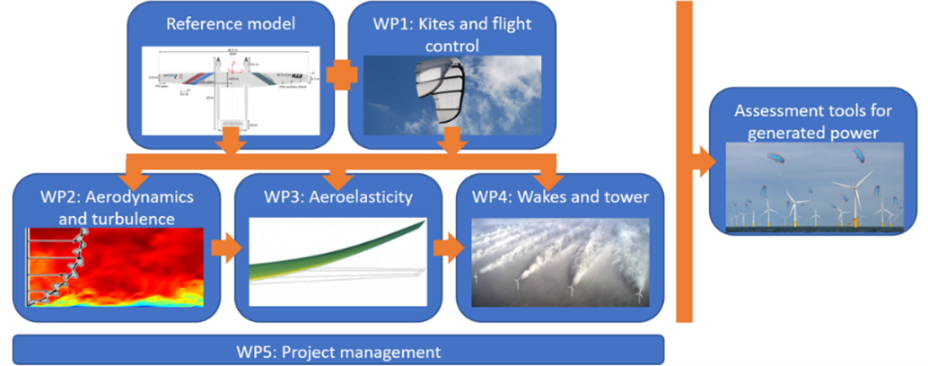
The work packages with the research are summarized by the following figure.
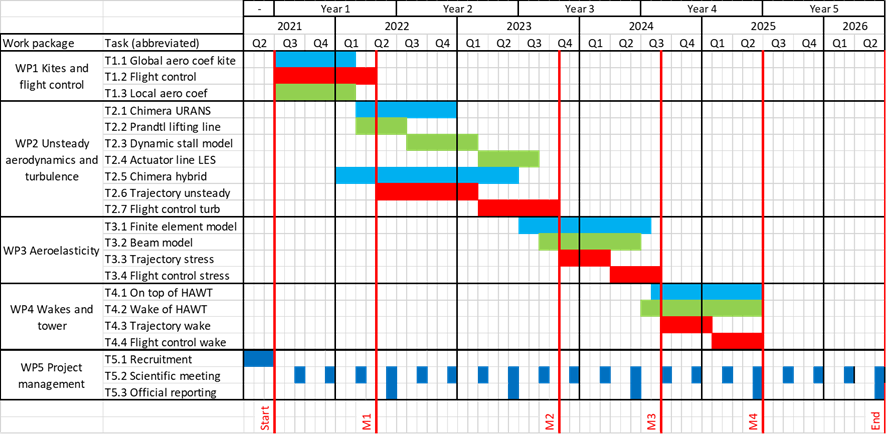
The timeline is shown in the following chart:
Publications
See also the UCLouvain library.
Videos
Visualization of the pressure distribution on the airborne wind energy system while flying a cross-wind flight maneuver. The pressure distribution changes during the course of the maneuver and has an asymmetrical distribution due to the higher speed of the outboard wing part.
Published in N. Pynaert, T. Haas, J. Wauters, G. Crevecoeur, and J. Degroote. Wing deformation of an airborne wind energy system in crosswind flight using high-fidelity fluid-structure interaction. Energies, 16(2):1–16, 2023. doi: 10.3390/en16020602.
Contour plot of wind velocity field in a plane parallel (left) and perpendicular (right) to the wind direction during the course of the cross-wind flight maneuver. It shows the induction of the AWE system on the uniform wind field.
Visualization of the wingtip vortices of the AWE system using the normalized q-criterion. The wingtip vortices follow the shape of the flight path but are convected downstream.