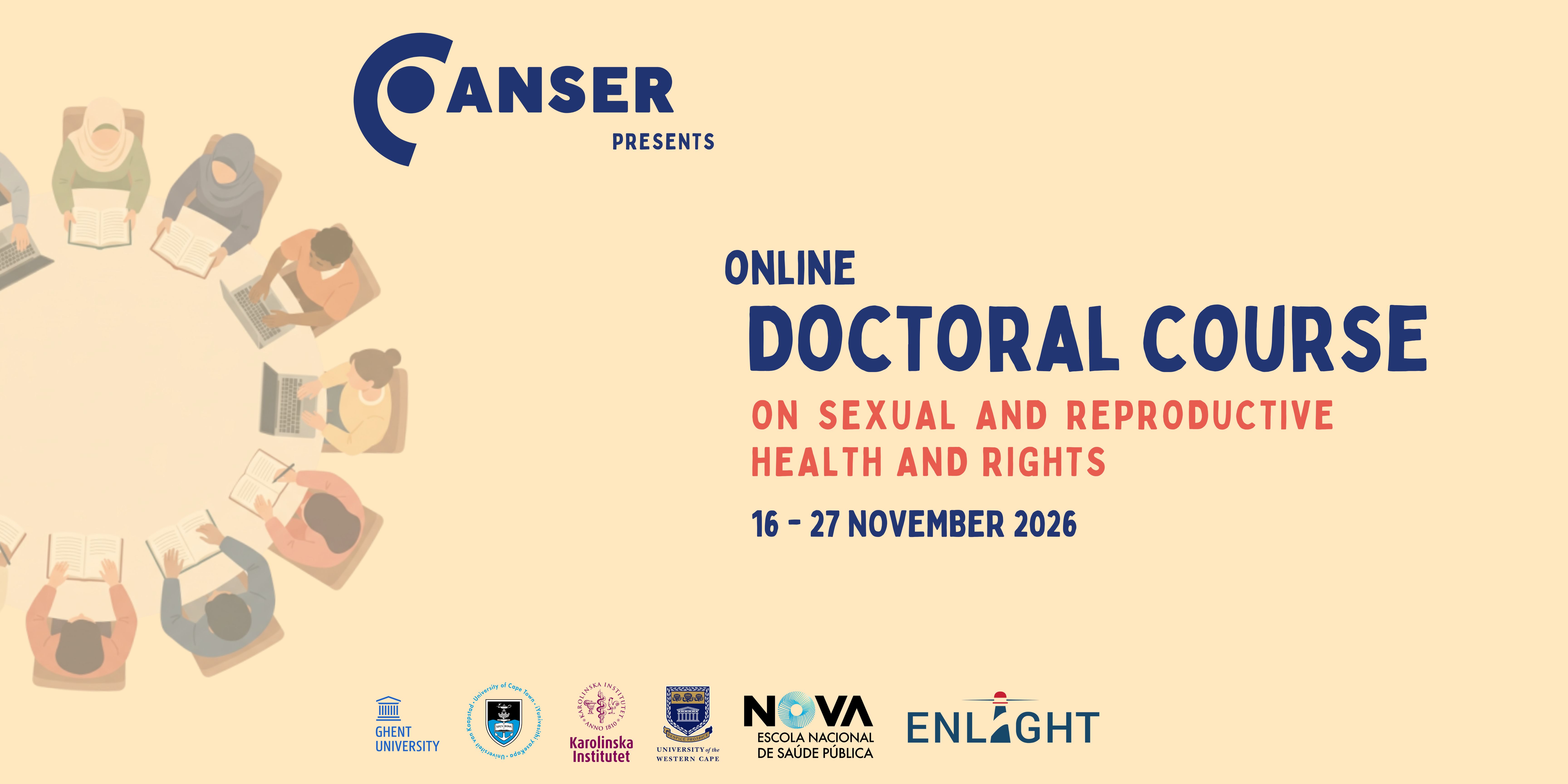
ANSER Doctoral Course 2026
A student's opinion on the course
Practical
Date: November 16th – 27th, 2026
Venue: Online (Zoom)
Organisers
This course is organised by Karolinska Institutet, Ghent University, University of the Western Cape, Universidade NOVA de Lisboa, and the University of Cape Town under the umbrella of the Academic Network on Sexual and Reproductive Health and Rights Policy (ANSER).
Purpose & intended learning outcomes
This course aims to show how crucial it is to understand how sexual and reproductive health and rights (SRHR) are shaped. While also showing the importance of its impact on future generations for all researchers involved in global health, maternal health, and many other health-related areas.
The course will also provide participants with practical and theoretical tools as well as background to review and carry out research in SRHR.
After having followed the course, the student should be able to:
Knowledge and understanding
- Describe and reason about the state of the art in SRHR, including global trends, progress, challenges and gaps in research
- Explain how structural factors – including social, political, economic and ethical factors - influence SRHR
Competence and skills
- Justify the application of qualitative and quantitative data and measurements in SRHR
- Apply skills for successful interdisciplinary collaboration (e.g. awareness of different perspectives on SRHR)
- Demonstrate skills in reviewing and critiquing scientific papers, e.g. provide feedback
Judgement and approach
- Examine SRHR Policies and their relation to SRHR outcomes, as well as ways to translate research into policy
Course content
- Introduction to core concepts and state of the art in SRHR in a global context
- Underlying causes of (in)equities in SRHR
- Intercultural and interdisciplinary academic collaboration
- Scientific societal outreach
- Sustainable Development Goals and other policy initiatives and their relation to SRHR globally
- Critiquing the literature in SRHR
Forms of teaching & learning
The entire course is online, given in English. It will include learning activities such as online lectures, joint readings, e-learnings, panel debates, group discussions, workshops and individual assignments. Lastly, the course places a strong emphasis on interaction and peer-to-peer learning, fostering active collaboration and exchange among students from the different participating institutions.
Time commitment
Participants should expect to dedicate time to both live sessions and independent learning. Over the two-week course period, classes will be held daily from 10:00-12:00 CET and 13:00-15:00 CET, although some sessions may be replaced by self-study moments. In addition, participants are expected to complete assigned e-learning modules, prepare for each session by reviewing the course materials, and complete a course assignment.
Participants also need to join an online information session on 9 November 2026 4-5pm CET.
Registrations:
Registration should be done in different ways, depending on your host institution:
Students from Karolinska Institutet:
Registration closed.
Students from the University of Cape Town:
Submit a short motivation letter and CV to Prof. Lucia Knight (Lucia.Knight@uct.ac.za) before the 11th of September 2026
Students from the University of the Western Cape :
Submit a short motivation letter and CV to Prof. Hanani Tabana (htabana@uwc.ac.za) before the 11th of September 2026.
Students from the Universidade Nova de Lisboa:
Submit a short motivation paragraph and CV to Dr Ana Gama (ana.gama@ensp.unl.pt) by the 11th of September 2026.
Students from Ghent University:
The course fee is €600. A refund can be claimed from the Ghent University Doctoral Schools' funds.
Please apply by sending a short motivation letter and CV to the ANSER secretariat (anser@ugent.be) before the 11th of September 2026.
Other students:
The course fee is €600. Please apply by sending a short motivation letter and CV to the ANSER secretariat (anser@ugent.be) before the 11th of September 2026.