Deliberation
Passing
A deliberation set is a fixed group of course units that is subject to deliberation (only under a contract to obtain a diploma). Deliberation sets are organised chronologically, following the full-time standard study track of the study programme as closely as possible.
- Passing a deliberation set means you have achieved a pass mark for every course unit within it. This includes scoring at least a 10/20 (or a pass mark) or receiving an exemption.
- Passing a study programme means you have passed every deliberation set of the study programme and/or have earned credits or exemptions for every course unit.
Please note: you must meet the study programme's admission requirements. If not, you are ‘inadmissible’ and cannot pass the study programme. Moreover, you must be enrolled in the programme and have a contract to obtain a diploma.
Deliberation
The term deliberation refers to making study progress decisions and may have various meanings (see below). The power of deliberation is the prerogative of the Examination Board.
Deliberation Rules
-
Deliberating on deficits in the first deliberation set ('first year') of a Bachelor's programme (cf. Article 67 of the Education and Examination Code)
In specific cases, an Examination Board may decide to deviate from the general passing criteria, which require obtaining at least a 10/20 in all course units. The Board may then choose to tolerate particular deficits. In such cases, the Examination Board will declare you as having passed, but you will not receive credit certificates for course units with a mark below 10/20. Additionally, these credits will not be added to your learning account.
-
The first deliberation set only includes course units programmed in the first year of the Bachelor's programme's standard study track.
-
The deficit for passing one or two course units is no more than 1% of the weighted total of the deliberation set - excluding exemptions - where ECTS credits are used as weights.
-
You have used the most recent exam opportunity for the relevant course unit, and this mark is used in the calculation.
-
You have achieved a minimum score of 8/20 across all course units.
-
You have scored less than 10/20 in no more than two course units.
-
You have obtained a minimum of 50% for the deliberation set.
The deficit is determined by multiplying the exam mark of the course unit by the number of ECTS credits allocated to that course unit.
The deliberation must not exceed 1%. This means that in a deliberation set containing 60 ECTS, no more than 12 points can be deliberated:
- e.g., one deficit for a 12-ECTS course unit; one 9/20
- e.g., two deficits for 6-ECTS course units; one 8/20 or two 9/20.
If you scored three 9/20 or one 7/20 in a deliberation set of 60 ECTS credits, you are not eligible for deliberation at all.
Sample Deliberation
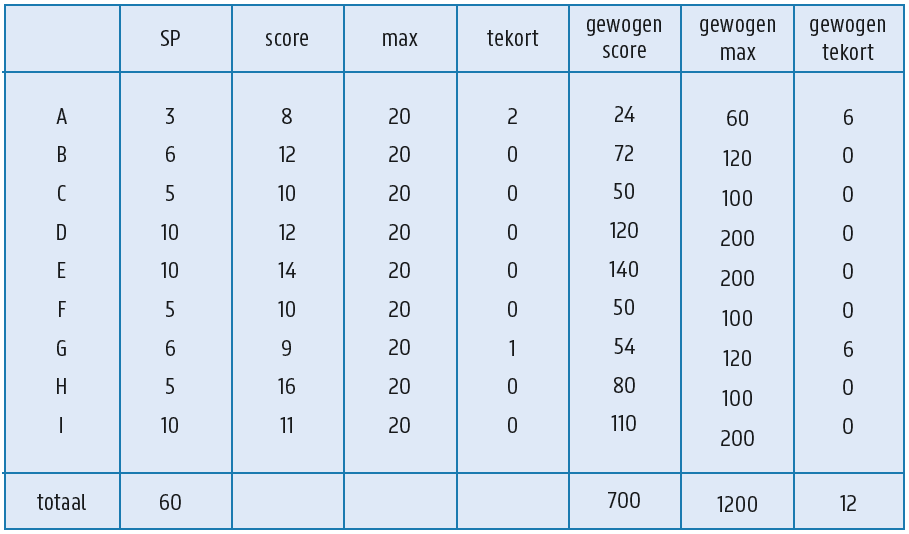
The chart below illustrates how we apply the deliberation rules during the first year of the Bachelor's programme. In the example, the first-year student will be deemed to have passed the deliberation set with one 8/20 and one 9/20: the overall score exceeding 50%, with no more than two deficits totalling no more than 1% of the weighted total, which is 12 points.
(SP=study points, tekort=deficit, gewogen score=weighted score, gewogen max=weighted total, gewogen tekort=weighted deficit)
-
-
Deliberating Deficits in a Graduation Year (Article 71 of the Education and Examination Code)
If you are enrolled in the graduation year of a Bachelor's programme, a preparatory or academic bridging programme, or an initial or advanced Master's programme, the Examination Board may decide that you have passed, provided the following cumulative conditions are met:
- You have taken up any remaining course units in your curriculum to pass the study programme.
- You have achieved at least 8/20 in all the course units.
- You have received less than 10/20 for no more than 2 course units.
- You have used the most recent exam opportunity for the relevant course unit, and this mark is included in the calculation.
- The deficit for passing 1 or 2 course units does not exceed 6 weighted marks, with the ECTS credits acting as weights.
- The Master’s dissertation and the mandatory work placements can never be deliberated.
The deficit is determined by multiplying the exam mark of the course unit by the number of ECTS credits allocated to that course unit.
More information
Review the corresponding articles (67 and 71) in the Education and Examination Code