DIAMOND: The smart bandage for diabetic wounds

The DIAMOND project aims to revolutionise care for diabetic patients by developing smart connected dressings. These devices will help to monitor and treat patients' wounds more effectively.
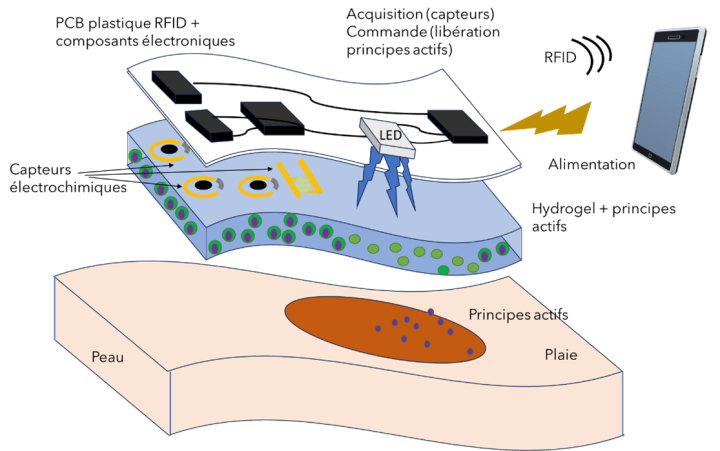
The aim is to develop a connected dressing for the wounds of diabetic patients, particularly on their feet, which are prone to ulcers. These dressings will contain sensors for real-time monitoring of biological parameters indicating infection or poor wound healing, and a stimuli-responsive hydrogel loaded with drugs that can be released on demand. At the end of the project, the solution developed will be transferable to dressing companies for large-scale application to treat all types of wounds.
Why are diabetic patients prone to foot ulcers?
Diabetes facilitates the development of infected lesions and leads to the development of foot ulcers, the most common, disabling and costly complications of diabetes. In 21% of cases, these ulcerous infections are followed by amputation.
How did this project come about?
There are currently two different treatments for diabetic foot ulcers. The first is to physically eliminate the bacterial biofilm by frequent debridement of the foot, which involves removing the necrotic tissue around and in the wound. This invasive surgery extends the healing period. The second treatment is antibiotics, which are becoming increasingly ineffective. Unfortunately, in the most serious cases, amputation remains the only alternative for containing the infection (8,400 amputations in France in 2016).
It has therefore become imperative to find new, more effective treatments to limit these disabling complications.
By developing our connected dressing, we will be able to deliver medicines directly to the wound at the most appropriate time. The patient will receive just the right amount of medication thanks to sensors placed in the dressing, which will detect the needs of the healing tissue and be able to activate the release of the active ingredients contained in the dressing's hydrogel into the wound. This treatment will be more effective and will have no toxic effect on the body.
Why does this issue particularly affect the France-Wallonie-Flanders region?
In the Hauts-de-France region and in Belgium, there is strong local demand for the monitoring and treatment of diabetic wounds. Hauts-de-France has the highest regional rate of people with diabetes (6.2%). In Belgium, 6.6% of the population have been diagnosed with diabetes, not including people who are unaware they have the condition. It is estimated that more than one person in three has diabetes, bringing the rate in Belgium to almost 10%.
These rates are set to rise over time as the population ages.
UGent CTSE is contributing its expertise in electrospinning nanofibre membranes to the development of the DIAMOND intelligent wound dressing. Different hybrid structures based on nanofibre membranes and hydrogels will be developed for the dressing. In addition, nanofibre membranes with a specific structure for the storage and release of drugs or active ingredients will be spun.
CTSE is also involved in the horizontal activities of the project: communication, dissemination and exploitation of project results. CTSE will therefore also participate in workshops/contact days/conferences and the like to make the project more widely known to the general public and the industry.
Further information
Acknowledgments
This project runs from 1 July 2024 to 30 June 2028 and is financed by the Interreg France Wallonia Flanders program for a total budget of 3.2 million euros and co-financed by Provincie Oost-Vlaanderen, VLAIO and Region Wallonne.



Partnership:

The Diabetes Liga and the HELORA University Hospital are associated partners.
Contact
Prof. dr. ir. Karen De Clerck (Karen.DeClerck@UGent.be)