Study Progress MonitoringThe Flemish Government expects students to obtain their higher education diploma within a reasonable time. Study progress monitoring measures and the learning account are used to ensure you make sufficient progress in your studies.
The Flemish Government expects students to obtain their higher education diploma within a reasonable time. Study progress monitoring measures and the learning account are used to ensure you make sufficient progress in your studies.
Study Progress
Study progress is the extent to which you advance in your studies and is based on your study success rate, which is calculated as follows:
Credits express the study time and the weighting attributed to a course unit in the curriculum. The credits in your personal curriculum are linked to the course units for which you enrolled in your first year of enrolment. Your acquired credits are those of the course units you have passed.
The study success rate is the ratio of the credits a student acquires in one academic year (i.e., by successfully passing exams) to the total number of credits in their curriculum (i.e., the set of course units).
If your study success rate is low - i.e. you fail to pass a sufficient number of course units - your subsequent enrolment may be subject to a study progress measure. Any measure to monitor study progress is recorded on your transcript of records.
This can take the form of:
a binding condition. This means that upon a subsequent enrolment in the study programme, you will have to meet that condition.
a refusal to enrol. This measure can be imposed immediately or, after not meeting the binding condition upon a subsequent enrolment.
If you are enrolled in several study programmes simultaneously (e.g., some Bachelor’s course units alongside the Master’s programme), your study progress is calculated separately for each programme.
Binding conditions apply to all language varieties of a particular study programme. Say you switch from the Dutch-taught programme to its English-taught equivalent, the binding condition will remain in place.
Monitoring Your Study Progress
If you are a Bachelor’s student, the Simon Says tool provides insight into your study success rate and personal study progress.
You will also see which study progress monitoring measures are in place and which actions you can take to maximise your success rate.
Visit www.simonzegt.beand use your Ghent University account to log in (the Simon Zegt tool is only available in Dutch).
Measures for Monitoring Study Progress for Students in the First Bachelor's
The application of study progress monitoring measures depends on your initial set of course units (i.e., the course units in your personal curriculum during your first year of enrolment in a study programme).
In your first year of enrolment, you must take 60 credits of course units (all the course units in the first-year standard track). However, some exceptions apply. A reduced initial set of course units can be granted:
when changing study programmes during the academic year (re-orientation)
to students who have been granted special status, including the ‘reduced curriculum’ accommodation
The 30% Rule after the First Year of Enrolment
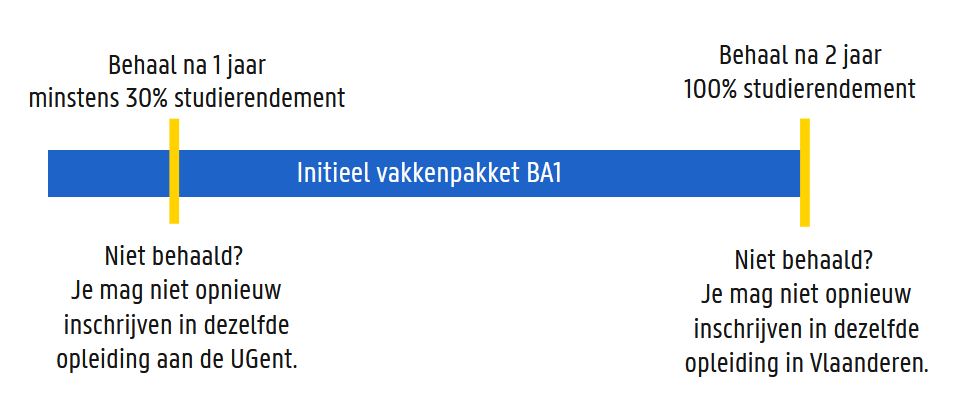
If you have not achieved a study success rate of 30% by the end of your first year of enrolment, you will be refused a subsequent enrolment in the same study programme at Ghent University.
Have you enrolled in a study programme with a benchmark test (info only available in Dutch)(in Dutch: 'starttoets' = ‘verplichte ijkingstoets')? If you did not pass the benchmark test and did not complete the mandatory remedial activities, you must achieve a study efficiency rate of 40% rather than 30% to continue the programme.
The 100% Rule after the Second Year of Enrolment
At other education institutions or in the media, you might have come across the term ‘threshold condition’ or in Dutch ‘harde knip’ (lit. ‘hard cut’).
Does your first enrolment in a Bachelor's programme predate the 2023-2024 academic year? If so, this measure does not apply to you.
If, after 2 years of enrolment, you have not passed, or been deliberated for the course units in your initial set of course units, you will no longer be allowed to enrol in the same study programme across the Flemish universities.
If your initial set of course units is smaller than 60 due to a late enrolment or re-orientation,
You will have to pass any remaining course units from the first deliberation set (first-year course units) of that programme (= the remaining set of course units).
You have two years of enrolment to complete this remaining set. If you do not succeed, you will be refused a subsequent enrolment in the same study programme at Ghent University.
Study Progress Monitoring Measures for all Ghent University Students
The monitoring measures described below apply to all Ghent University students at the end of each academic year, irrespective of their study programme or curriculum. These measures apply to Bachelor's and Master’s programmes, preparatory programmes and academic bridging programmes, as well as to microcredentials.
The 50% Rule
If you have not achieved a study success rate of 50% by the end of your first year of enrolment, you will need to achieve a study success rate of at least 50% upon a subsequent enrolment in the study programme. If you do not achieve this, you will be refused a subsequent enrolment in the study programme at Ghent University.
The 1/3 Rule
If you have not obtained credits for 1/3 of the course units in your personal curriculum over the past 3 years of enrolment at Ghent University, you will be refused enrolment in all study programmes at Ghent University. This refusal applies to all contract types and study programmes at Ghent University and remains in force for 6 academic years.
For example: in the 2021-2022 academic year, you obtained only three of the total of 60 credits. in the 2022-2023 academic year, you obtained 30 of the total of 60 credits. in the 2023-2024 academic year, you obtained eighteen of the total of 60 credits.
Over the past three years of enrolment, you obtained 51 of the total of 180 credits, which is below 1/3. At the close of the resit exam period, your transcript of records will include the message stating that you can no longer enrol at Ghent University, irrespective of the study programme or contract type.
You have enrolled in the same course unit twice without obtaining credits
You will no longer be allowed to enrol in the same course unit with a contract to obtain credits. However, you are still allowed to enrol with a contract to obtain a diploma (info only available in Dutch) provided that you do not run into any other study progress monitoring measures.
Study Progress Measures for a Contract to Obtain Credits
To students who enrolled with a contract to obtain credits, the following applies:
The 1/3 rule:
If you have not obtained credits for 1/3 of the course units in your personal curriculum across the past three years of enrolment at Ghent University, you will be refused a subsequent enrolment in all study programmes at Ghent University. This refusal applies to all contract types and study programmes at Ghent University and remains in effect for 6 academic years.
'You have enrolled in the same course unit twice without obtaining credits':
You will no longer be allowed to enrol in the same course unit with a contract to obtain credits. However, you are still allowed to enrol with a contract to obtain a diploma (info only available in dutch), provided that you do not run into any other study progress measures.
An enrolment with a contract to obtain credits affects the learning account (info only available in dutch) differently.
Learning Account
Aside from the study progress measures (established by the government and Ghent University), the Flemish Government has also established the learning account. The credit system is used to determine whether you have passed a sufficient number of course units. Visit the Flemish Government's website My Citizen Profile ('Mijn burgerprofiel', info only in Dutch) to check the balance in your learning account.
A refusal to enrol means you can no longer re-enrol, either in a particular study programme or in any programme at Ghent University. All depends on the reason for refusal (cf. study progress monitoring).
You can lodge an appeal against a refusal to enrol, in accordance with the procedure set out in the Education and Examination Code, Article 81§1. You must do so within seven calendar days of the refusal being communicated. If you choose not to lodge an appeal, the refusal to enrol remains in place for one academic year. It is extended by one year upon each new attempt to re-enrol, unless the Institutional Appeals Committee commutes the refusal into binding conditions as a result of an internal appeals procedure.
A refusal to enrol expires automatically after six academic years.
A refusal to enrol in an initial Bachelor’s programme expires automatically when the student obtains another Bachelor's diploma.
Can I Lodge an Appeal?
Annually, you can lodge an appeal with the Institutional Appeals Committee against binding conditions and a refusal to enrol. In cases of force majeure or exceptional individual circumstances, the Committee can overrule a refusal to enrol. In such cases, it can also impose binding conditions.
Please note that different procedures apply to the learning account (info only available in Dutch).
Contact
If you have doubts about the applicable measures or are unsure how to proceed in your specific situation,
please contact the study track counsellor (info only available in Dutch) of the study programme.