Facilities at LumiLab
More services and facilities can be found within the Department of Solid State Sciences or the Center of Expertise at NB-Photonics.
Perkin Elmer multifunctional spectrophotometers
Two Perkin Elmer Lambda 1050 UV-Vis-NIR spectrophotometers for both specular and diffuse transmission and reflection measurements. One of the instruments is dedicated to diffuse transmission and reflection measurements, using an integrating sphere or praying mantis. Using the latter attachment, measurements can be performed under a controller atmosphere and at elevated temperature. The other instrument is equipped with a TAMS (total absolute measurement system) and can be used for angle dependent transmission and reflection measurements under controlled polarization conditions, including measurement of BRDF (bidirectional reflection distribution function) and mapping of wafer surfaces.

Fluorescence spectrometer
Photoluminescence setup, enabling high resolution excitation and emission measurements. The combination of a Xe arc lamp and a double excitation monochromator allows selecting an excitation in the range from 250 to 900nm, with narrow band width and low stray light. At the emission side, two detectors are available for measurements between 300 and 1650nm. The setup can be extended with a cryostat, for measurements between 4 and 500K.
Type: Edinburgh FS920

ToupTec camera
ToupTec MAX04BM monochrome scientific 4.2 MP back-illuminated sCMOS camera (GSENSE2020BSI), UV-optimized process, USB3.0 interface, supports HDR 16-bit output. Features TEC cooling (typical ΔT ≈ 40 °C) and anti-condensation structure, suitable for UV/low-light imaging and spectral detection in scientific applications.

XenICs SWIR camera
XenICs Xeva-1.7-320-TE3-USB-100, a high-performance, thermoelectrically cooled short-wave infrared (SWIR) imaging camera. Built around a monolithic InGaAs focal plane array (FPA), the camera operates on the principle of photon detection in the 0.9–1.7 µm wavelength band. Its three-stage thermoelectric (TE3) cooler stabilizes the detector at –40 °C, suppressing dark current to <100 e⁻/pixel/s and enabling long integration times without significant thermal noise accumulation.
Key Features: Monolithic InGaAs sensor with 320 × 256 active pixels and uniform 30 µm pixel pitch, optimized for high quantum efficiency (>70% across 1.0–1.6 µm).

Intensified CCD
This instrument is used for measuring integrated and time-resolved optical emission spectra (both electro- and photoluminescence). On periodic signals, a time resolution down to 2 ns can be obtained. It is coupled to a 0.5 m Ebert monochomator. For photoluminescence decay measurements, a 337 nm pulsed nitrogen laser is available (pulse length < 1ns). Using the dye extension, the excitation can be tuned between 360 and 600nm.
Type: Andor DH720

Tunable laser
Our tunable laser system comprises a nanosecond optical parametric oscillator and Q-switched pump laser in a single housing. It features hands-free wavelength tuning from 210 nm to 2600 nm, a 10 Hz repeptition rate, 4 ns pulse duration at an energy of about 10 mJ. Direct outputs at 1064 nm, 532 nm and 355 nm are available. Useful for decay time measurements, laser ablation and excitation and charging of phosphor materials.
Type: Ekspla NT340

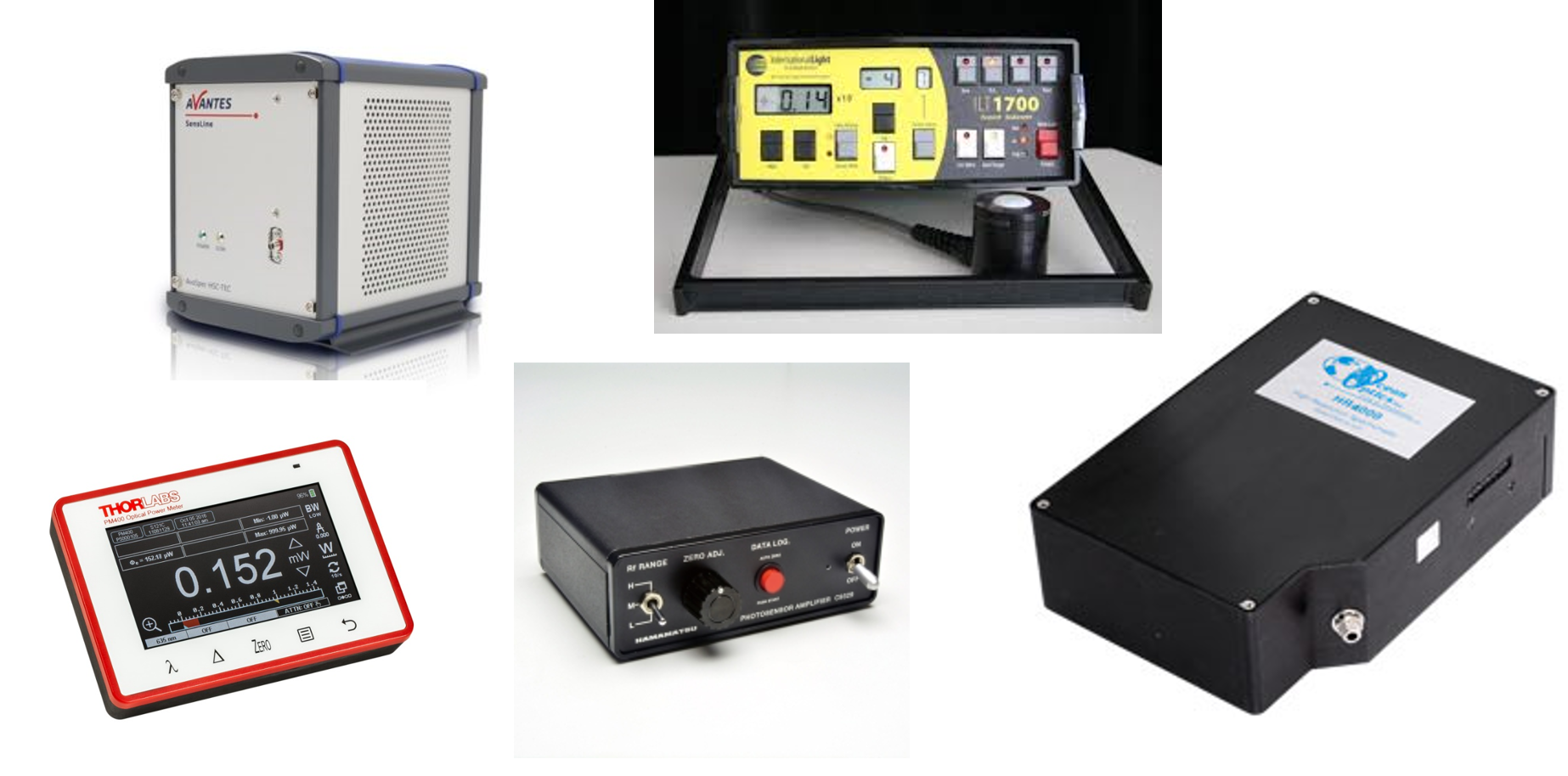
Portable light detectors
Mixed bag of detectors for photometry, radiometry and spectroscopy.
Types: Ocean Optics HR2000+ and QE65000, AvaSpec HERO and NIR, ILT1700, etc.
Infrared camera
This accurate non-contact temperature sensors offers comprehensive visual temperature monitoring of our experiments.
Type: FLIR A35

TL/TQ setup
Homemade setup for thermoluminescence spectroscopy with low energy photon excitation.
Scanning electron microscope
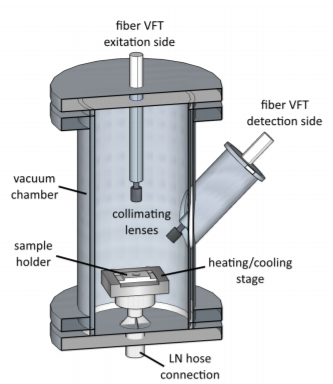
Fully automated VP-SEM equipped with a number of extensions for chemical and structural analysis. These features include EDX (energy dispersive x-ray analysis), CL (cathodoluminescence) and a cooling/heating stage.
Type: Hitachi S-3400N

Photocatalysis setups
Photocatalytic reactors for investigating the breakdown of VOCs (volatile organic compounds) in air. Two types of reactors are available:
- A stainless steel batch reactor which can be evacuated using a turbomolecular pumping system. Illumination is using a single high power 365 nm LED, but the setup can also be configured with other light sources. A Hiden quadrupole mass spectrometer (QMS) is used for gas analysis.
- A quartz tube reactor which can be used both in batch and flow mode, developed for using membranes as photocatalysts. Illumination is performed from 4 sides of the quartz tube with 48 high power UV LEDs. The same QMS is used for gas analysis. An identical reactor is installed in the Plasma Physics research group, combining atmospheric plasma gas treatment with photocatalysis.


Furnaces
A series of tube and muffle furnaces is available for synthesis, annealing and sintering under air, vacuum, inert or reactive atmosphere.

Ball mill
Planetary ball mill for powerful and quick grinding of material with feed size < 10 mm resulting in a final fineness < 1 µm, or for colloidal grinding < 0.1 µm. This benchtop model consists of 1 grinding station equipped with a ZrO2 grinding jar (50 ml). Both dry and wet grinding are possible.
Type: Retsch PM 100

Climate chamber
With this device accelerated aging can be tested at a combination of high temperature and humidity.
Type: Memmert HCP 108

Glovebox
The glovebox working station offers an oxygen-free atmosphere to store and prepare samples.
Type: MBRAUN LABstar
