Taxation Research Group
News and Events
-
New publication: De Belgische meerwaardebelasting op financiële vaste activa: kritische reflecties van stakeholders
Deze studie onderzoekt hoe politici, fiscaal adviseurs, academici en belastingplichtigen het voorstel over de meerwaardebelasting percipieerden kort na de publicatie van het federaal regeerakkoord op 31 januari 2025. Hoewel de potentiële belastingdruk in vergelijking met de buurlanden relatief mild oogt, verschillen de veertien respondenten in hun mening over de rechtvaardigheid van de Belgische belasting en de invulling van de specifieke modaliteiten. Alle geïnterviewden daarentegen geven aan dat de bepalingen van het toepassingsgebied, de tarieven en de vrijstellingen veelal arbitrair ogen. Een grondige motivering achten zij noodzakelijk om discriminatie en rechtsonzekerheid te voorkomen. Daarnaast wordt de waardering van niet-beursgenoteerde aandelen als een groot discussiepunt aanzien. De budgettaire impact van de meerwaardebelasting, alsook de reacties van beleggers en ondernemers in termen van verkooptransacties of kapitaalvlucht schatten de respondenten uiteenlopend in. Het is dan ook waardevol om deze effecten te bestuderen via toekomstig wetenschappelijk onderzoek.
Roggeman, A., Broos, J., Daemers, E., & Jacobs, A. (2025). De Belgische meerwaardebelasting op financiële vaste activa: kritische reflecties van stakeholders. Accountancy & Bedrijfskunde, 4, 63-75. Link.
-
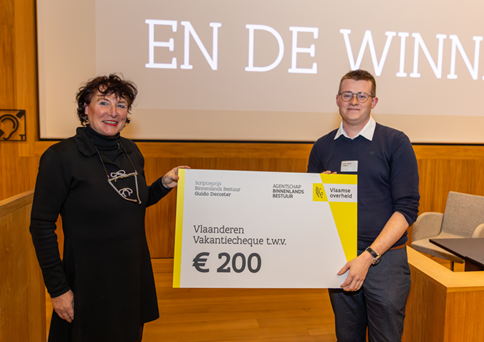
'Vlaamse Scriptieprijs Binnenlands Bestuur: Guido Decoster 2025' voor Ruben Vander Haeghen
Ruben Vander Haeghen wint als tweede plaats de prijs Binnenlands Bestuur voor zijn masterproef ‘How do political parties affect the financial health of Flemish municipalities’? onder promotorschap van prof. dr. Annelies Roggeman. Van harte proficiat!
Door tien jaar aan financiële data te koppelen aan inzichten uit de political economy en public choice theory, toont Ruben aan hoe coalities, partijvoorkeuren en electorale druk het financieel beleid van Vlaamse gemeenten vormgeven. Enkele belangrijke bevindingen:
- Linkse coalities zorgen gemiddeld voor een hogere belastingdruk dan rechtse of centrumrechtse coalities.
- Regeringscoalities met een grote mate van interne ideologische spreiding of polarisatie leiden tot hogere uitgaven per inwoner.
- Budgettaire tekorten zijn niet zozeer gekoppeld aan de ideologie van de coalitie maar aan (pre)verkiezingsjaren.
Bezoek ook zeker de video waarin Ruben zijn onderzoek aan u voorstelt:
-
New publication: R&D tax credits, innovative activity and the targeting approach
The aim of this study is to investigate if the French R&D tax credit targeted at small and medium-sized enterprises (SMEs) has a positive impact on innovative activity. The French institutional setting provides a unique research setting as the R&D tax credit targeted at SMEs only applies to expenditures incurred during the development phase of R&D projects instead of all eligible R&D expenditures. In order to explore the effectiveness of the French R&D tax credit, a regression discontinuity design (RDD) is applied by comparing targeted SMEs with larger firms not subject to the tax credit over the period 2014-2018. In general, we find that the French R&D tax credit has a positive impact on innovative activity. Moreover, SMEs react more strongly to this incentive in their growth stage. The findings suggest, however, that this effectiveness in increasing SMEs’ innovation does not persist over time.
Gjymshana, E., Roggeman, A., & Verleyen, I. (2025). R&D tax credits, innovative activity and the targeting approach. Economics and Business Review, 4, in-press. DOI:https://doi.org/10.18559/ebr.2025.4.2306.
-
PhD Defense: The effects of tax incentives on corporate innovation: Empirical analyses – Erik Gjymshana

The central theme of Erik’s doctoral dissertation is the relationship between corporate taxation and innovation. His research specifically examines how tax incentives influence firms’ innovative activity.
Governments initially support innovation primarily through subsidies, but over time they have increasingly relied on tax-based measures such as R&D super deductions, tax credits, and patent boxes. Using quantitative analysis and a range of econometric techniques, Erik estimates the causal effect of these tax incentives on corporate innovation. The results indicate that, when carefully designed and implemented, tax incentives can effectively stimulate innovation at the firm level.
For policymakers, the main recommendation of the dissertation is to choose between two consistent approaches: adopting a more generous incentive system, as seen in countries like Belgium, France, Ireland, and the UK, or pursuing a more neutral system, as practiced in Sweden and Estonia.
-
New publication: Reduced recruitment success as a deterrent to tax aggressiveness: evidence from tax and nontax students’ job pursuit intentions
While prior reputational cost studies have focused predominantly on the reactions of investors and consumers, current labor shortages and the associated war for talent made us shift attention to job seekers.
In an online experiment with 439 final-year students from five Belgian universities, we show that reports of tax aggressiveness could pose harm to the company’s recruitment success. Thereby, legality serves as an important reference point in that tax avoidance is generally not as detrimental as reported engagement in tax evasion. Nonetheless, even tax avoidance could still backfire through missing out on positive word-of-mouth.
Dekoster, K., Verleyen, I., & Roggeman, A., (2025). Reduced recruitment success as a deterrent to tax aggressiveness: evidence from tax and nontax students’ job pursuit intentions. Accounting Research Journal 2025. DOI:https://doi.org/10.1108/ARJ-11-2024-0395
-
The second edition of the Ghent Conference on International Taxation (05/05/2025-06/05/2025)
Our research group hosted the second edition of the Ghent Conference on International Taxation, bringing together a diverse group of academics from across Europe. The event provided a dynamic platform for discussing recent developments and emerging trends in international taxation through a series of insightful presentations and engaging discussions.
We were honoured to welcome two distinguished keynote speakers. Caren Sureth-Sloane offered valuable perspectives on the perception and effects of business taxation, emphasizing how collaboration and academic exchange foster deeper insights. Niels Johannesen addressed taxation in a globalized world, underlining the critical role of cross-border information exchange in shaping effective tax policy.
We are grateful to all participants for their open and constructive contributions, which greatly enriched the conference experience. We hope the event offered inspiration, meaningful connections, and a fruitful exchange of ideas for everyone involved.

-
PhD Defense: Corporate Taxation: A Corporate Social Responsibility Concern - Catherine Acosta Garcia

While tax laws are established at the national level, many businesses operate globally, creating gaps between where value is generated and taxes are paid. Corporate strategies that exploit these gaps for tax reduction raise concerns about businesses’ commitment to corporate social responsibility (CSR), as such practices may contradict CSR’s ethical principles.
Catherine’s doctoral research examines the relationship between CSR and taxation in listed multinational firms. Through three studies, this research enhances the understanding of CSR and corporate taxation, offering insights to promote business tax responsible practices.
The findings highlight the importance of economic freedom in shaping CSR’s impact on corporate tax avoidance, with this moderating effect being stronger in countries that exhibit lower tolerance for power inequality.
The research also demonstrates that tax transparency regulations, such as public Country-by-Country Reporting (CbCR), influence European multinational banks' CSR performance. However, the improvements are more evident in policy- and target-oriented CSR initiatives rather than in measurable outcomes. Additionally, a critical discourse analysis of two European electric firms’ tax transparency reports reveals that corporations use these reports to justify their tax practices by appealing to authority, values, and rational arguments, thereby framing themselves as tax responsible actors. The study warns that tax transparency disclosures may create an illusion of accountability without meaningful reform, urging stakeholders to critically assess corporate tax transparency reports.
Executive Summary and PhD Thesis
-
New publication: Mandatory public country-by-country reporting for multinational enterprises: hoping for the best, preparing for the worst?
This study investigates multinational enterprises (MNEs)’ concerns regarding the introduction of mandatory public country-by-country reporting for large multinationals operating in the European Union, as mandated by Directive 2021/2101/EU. Considering the substantial time window between announcement of the directive and the first year of reporting, we also explore how MNEs attempt to mitigate their concerns in the run-up period to its implementation. Through in-depth interviews with experienced tax consultants, we identify the fear for misinterpretation and reputational damage as MNEs’ most pressing concern. This issue has garnered the attention of senior executives, such as CFOs and CEOs, who are increasingly involved in managing this risk. To address the concern, MNEs hope to find a solution in storytelling and plan to voluntarily disclose additional narrative framing to enrich the poorness of the quantitative disclosures.
Dekoster, K., Verleyen, I., Bekaert, D., Ruzeré, D., & Wittevrongel, M., (2025). Mandatory public country-by-country reporting for multinational enterprises: hoping for the best, preparing for the worst?. Accountancy & Bedrijfskunde, 2024(4), 55-68. Link.
-
New publication: Compliance with base erosion and profit shifting action 13: Insights from tax consultants and tax officials
To combat firms exploiting transfer pricing as a tool for tax avoidance, the Organisation for Economic Cooperation and Development (OECD) introduced the Base Erosion and Profit Shifting Action 13 (BEPS 13), enhancing tax transparency and the exchange of information with tax authorities. Interviewing senior-level transfer pricing advisors and tax officials, we investigate how and why multinational enterprises (MNEs) respond to this new regulation. By conducting this research, we contribute to the scarce literature assessing the impact of tax disclosure to tax authorities and, specifically, the implications of BEPS 13. The study finds that MNEs attach more importance to tax compliance and are more averse towards tax avoidance, which is mainly driven by higher audit pressure. Additionally, MNEs experience additional costs to comply with the different implementations in countries, centralise tax data with IT systems within the organisation, and set up multilateral Advance Pricing Arrangements (APAs) and Mutual Agreement Procedures (MAPs). To avoid (other forms of) tax avoidance being considered by companies, policymakers should address these concerns of increased compliance costs.
Roggeman, A., Aro-Sati, L., & Verleyen, I., (2025). Compliance with base erosion and profit shifting action 13: Insights from tax consultants and tax officials. European Research on Management and Business Economics. DOI: https://doi.org/10.1016/j.iedeen.2024.100267
The Taxation Research Group at the Faculty of Economics and Business Administration of Ghent University is proud to invite you to the second edition of the Ghent Conference on International Taxation, which will take place on 5 and 6 May 2025 in Ghent, Belgium.
The aim of this conference is to provide scholars working on international taxation research from a (business) economics point-of-view with the opportunity to share and discuss their recent work. Topics may include, but are not limited to: tax avoidance, reporting, compliance, transparency, harmonization, and managerial decisions.
Each presenter will receive individual comments on their research project from a discussant. Additionally, feedback will
be received from the attendees, keynote speakers, and organizers in a friendly atmosphere.
Keynote speakers
We are happy to announce that our two keynote speakers for this edition will be:
Prof. Dr. Caren Sureth-Sloane
Paderborn University and TRR 266 Accounting for Transparency
Prof. Dr. Niels Johannesen
Oxford University Centre for Business Taxation
Submission guidelines
Please submit your full paper or extended abstract (3 to 5 pages) to TaxationConference@UGent.be in Word or PDF format by Monday, 20 January 2025. Notifications of acceptance will be sent out in early March.
Conference registration
The registration fee of €150 will cover all catering and social
events during the conference. More details regarding
registration will follow soon.


Research
Our research group mainly focuses on topics in corporate taxation at the national and international level, which can be related to other disciplines like accounting, finance, management or economics. We deal with the following broad areas:
• Tax incentives for business
• Measures against tax avoidance of multinationals
• Shareholder perceptions of tax avoidance
• Tax avoidance and corporate social responsibility
• Green taxation of companies

A common characteristic of our research is that the research topics have a grounding in real-world practice. Our research strategy is based on sound theoretical frameworks and advanced research methods.
Team

Education
Events
- Internationalization@home - 2024 - Ghent
- Residential Seminar - 2023 - Knokke
- Excursion Parliament - 2023 - Brussels
- Meet & Greet Alumni - 2023 - Ghent
- Think & Talk Honoursprogram - 2021-22 - Ghent
Contact
Adress
Ghent University
Faculty of Economics and Business Administration
Department of Accounting, Corporate Finance and Taxation
Sint-Pietersplein 7
9000 Ghent
Belgium
Questions
For general questions please contact our secretary staff at info.eb22@UGent.be or +32 9 264 35 49.