UGent Leest

UGent Leest is an initiative by the Faculty of Arts and Philosophy to get students, staff and alumni to read more. The project was made possible by the legacy of a former teacher, librarian and alumna of the faculty.

UGent Leest - logo

Welcome to UGent Leest! The first two initiatives on the calendar: a monthly ‘Silent Book Club' and five reading groups. In a later phase, the project will also focus on training programmes on reading promotion through the Humanities Academie, the faculty's lifelong learning platform.

UGent Leest collaborates with Iedereen Leest, an organisation that wants to build a strong and broad reading culture in Flanders and Brussels with campagnes such as the Voorleesweek. The Iedereen Leest Academie offers training courses on reading promotion for professionals and volunteers.

Keep an eye on this page for more news about UGent Leest.

Reading groups 2025 - 2026

Five avid readers/writers affiliated with the university each chose a book that they will read together and discuss with a group of UGent'ers (colleagues, students, alumni). The reading groups all take place at the faculty library (Rozier 44, Gent).

Registration opens 22 September 2025 at 9h. Each reading group can be joined by 12 UGent'ers. You can register for one reading group.


Petra De Sutter (rector Ghent University): 'The Master and Margarita' (Mikhail Bulgakov)

In Stalinist Moscow, the devil appears with his bizarre entourage. Chaos breaks out, reality fades. The Master and Margarita is a daring, satirical and deeply philosophical novel about power, love and truth. Bulgakov's masterpiece is at once magical, dangerous and irresistibly topical.

Together we discuss: Power and censorship; religion and ideology; truth versus madness; good versus evil; freedom of thought and imagination.

Date: 10 December, 7 - 9 p.m.

-> Register

Petra De Sutter UGent Leest

De meester en Margarita


Stefan Hertmans (UGent alumnus of the year 2025): “Home Fire” (Kamila Shamsie)

A surprisingly contemporary version of Sophocles' Antigone as a British-Pakistani woman, embroiled in a heart-rending story about politics, integration and morality.

Together we discuss: Moral dilemmas in times of great social change, personal morality versus the law, the relevance of Greek tragedies to our times, the “tribal” bond versus politics.

Date: 22 October, 7.30 p.m. - 10 p.m.

-> Register

Stefan Hertmans UGent Leest

Huis in brand


Anne-Laure Van Bruaene (lecturer in cultural history of the early modern period): 'Wildevrouw' (Jeroen Olyslaegers)

Wildevrouw is a historical novel that aims to bring the turbulent sixteenth century to life. Like Louis Paul Boon's Geuzenboek (1979), it offers an irreverent view of a period of artistic and intellectual heights, but also of hypercapitalism, social inequality and religious polarisation. Wildevrouw is largely set in Antwerp, then truly a metropolis, where the “golden age” came to an abrupt end due to Protestant iconoclasm and political unrest.

Together we discuss: This reading group focuses on the genre of the historical novel. Taking the turmoil of the sixteenth century as our starting point, we explore together the tension between the past and the literary imagination of that past. Why is the historical novel so popular? Do historians read historical novels? Does the historical novel cloud our understanding of the past? Or can the detachment of the historian and the empathy of the novelist complement each other to arrive at a better picture of history?

Date: 21 November, 4 - 6 p.m.

-> Register

Anne-Laure Van Bruaene

Wildevrouw


Ilse Logie (lecturer in Hispanic American literature): “Gif” (Samanta Schweblin)

The Argentine pampas evoke images of vast plains and invigorating nature. But in the dystopian Distancia de rescate (2014) – translated into Dutch as Gif – that expectation quickly turns into an oppressive nightmare. Samanta Schweblin (Buenos Aires, 1978), one of the leading voices in contemporary Latin American literature, draws you into a story with breathtaking precision that literally gets under your skin. Poison is a psychological thriller about suffocating maternal love and ecological horror – a novella that you sometimes have to put down, but keep picking up again. A chilling example of what literary fiction can do.

Together we discuss: The main themes of this book, which balances on the border between realism and the supernatural: on the one hand, “poison” as a central motif, the invisible damage caused by progress with far-reaching consequences for humans and nature, and, on the other hand, the paradoxes of motherhood (an extreme urge to protect, but at the same time the impossibility to protect a child from greater forces). We also look at the build-up of tension and certain narrative aspects and examine why this reading experience is so oppressive.

Date: 11 December, 6 - 8 p.m. (In consultation with the participants, we will consider whether a second meeting would be useful.)

-> Register

Ilse Logie

Gif


Christopher Markiewicz (professor Ottoman history): "The Lazarus Project" (Aleksandar Hemon)

In the early 20th-century, Lazarus Averbuch, an immigrant from Eastern Europe is shot dead in the home of the chief of police in Chicago. A century later, Vladimir Brik, another eastern European immigrant to Chicago, enlists his friend Rora—a war photographer from Sarajevo—to join him in a journey retracing Averbuch’s path to America. Through a history of pogroms and migrant politics, memories of war-torn Bosnia, and encounters with mafiosi and human traffickers, the stories of Averbuch and Brik become intertwined to explore the immigrant experience in America. At times irreverent and at time profound, Hemon writes fiercely and freshly.

Together we discuss: Migration, assimilation, and identity; journeys of self-discovery; autobiographical fiction.

Date: 13 November 5 - 7 p.m.

-> Register

C. MarkiewiczThe Lazarus Project


Silent Book Club 2025 - 2026

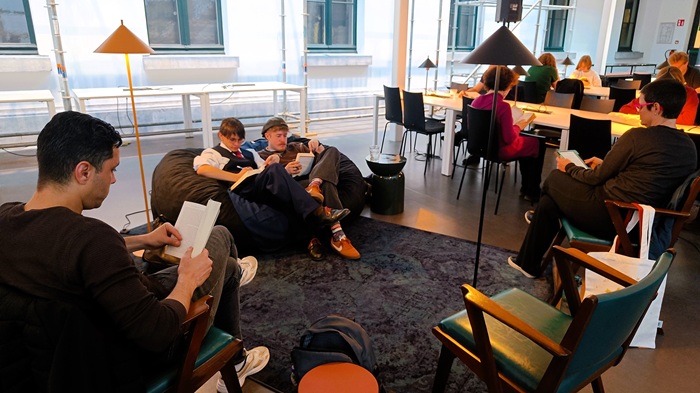
UGent Leest 1Every last Monday of the month, part of the faculty library (Rozier 44) will be transformed into a cosy ‘Silent Book Club’.

We offer a cosy place where you can read in silence for an hour with a drink within reach. No technology is allowed so that participants can read their favorite books in silence. Bring your own book or borrow one from the collection. If you want, you can talk about your book with other participants afterwards.


Dates

From 19:00 at the faculty library.

Revisit the kick-off of UGent Leest 2024 - 2025

On 20 February 2025, the kick-off of UGent Leest took place in the Belvedère of the Boekentoren. Dean Gita Deneckere and faculty librarian Paul Buschmann introduced the project. Ish Ait Hamou, Ghent University honorary doctor, talked about his experiences as a reader and writer and the leaders of the reading groups shared the book they chose for their reading group. Peter Van den Eede (Uitgelezen op School) acted as moderator. There was also a brainstorming session on how to further shape the project, first within Ghent University itself and later on in a broader sense.

Photography: Kitty van de Waart