Future plan for campuses in Ghent by 2050Ghent University is developing an ambitious long-term plan for its campuses. By 2050 all 11 faculties located in Ghent will be accommodated within three clusters.
Ghent University is developing an ambitious long-term plan for its campuses. By 2050 all 11 faculties located in Ghent will be accommodated within three clusters.
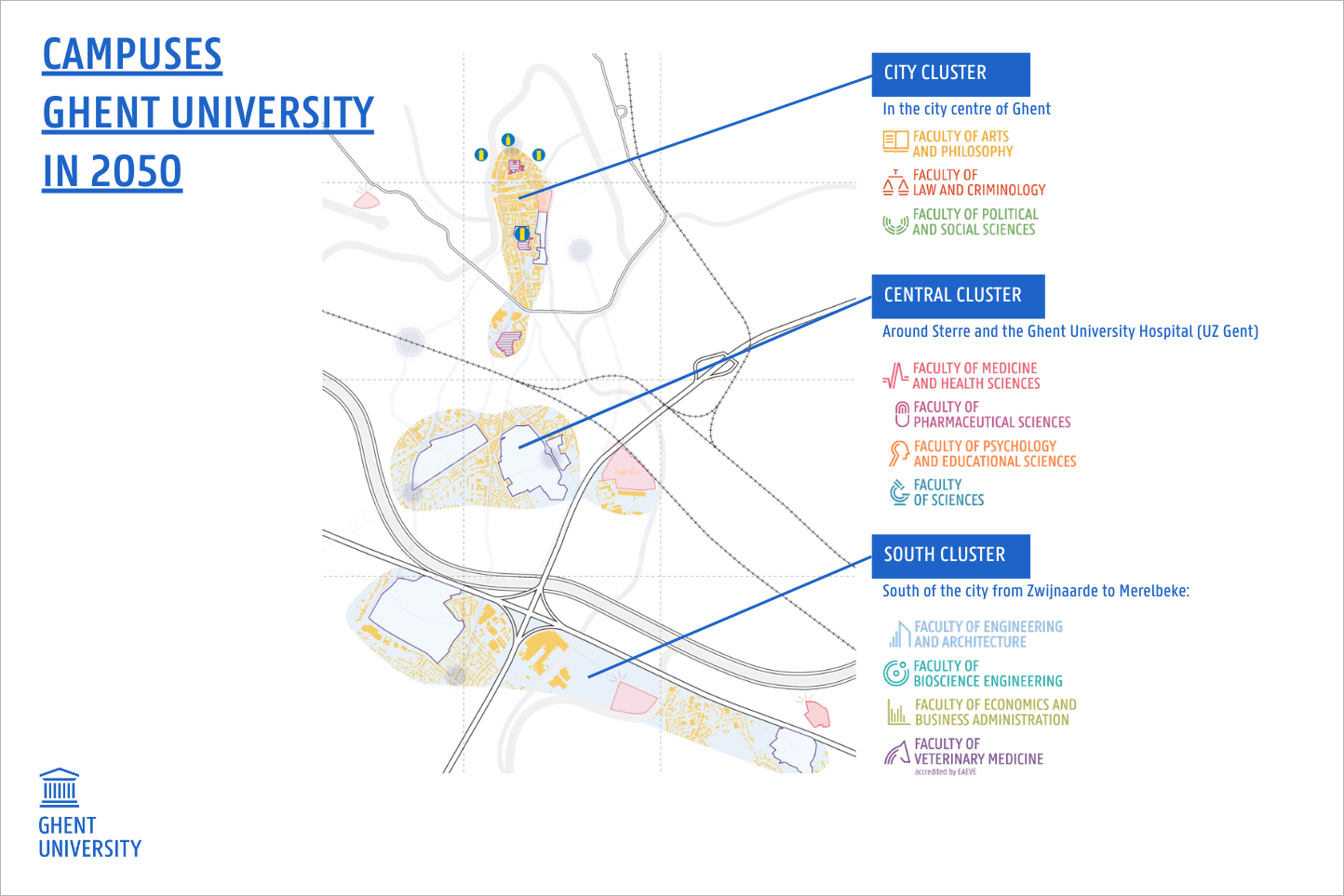
The three clusters lie along an imaginary axis: from the city centre, via Campus Sterre and the Ghent University Hospital (UZ Gent), to the south of the city. In the course of this reorganisation the university will say farewell to a number of campuses.
With this long-term plan Ghent University intends to renew its infrastructure and prepare it for the challenges of the coming decades.
From around 20 scattered campuses to 3 university clusters
Ghent University aims to transform these three zones into clearly defined campuses, where buildings are meaningfully connected, where there is abundant green space, and where students and staff can work, study and collaborate in a sustainable way — and where students can live. Functions will be brought together: attending classes, conducting research, working and collaborating.
The implementation of this vision will be accompanied in the coming years by continuous consultation at both local and supra-local level. The various permits required to carry out this plan are crucial and numerous. With this in mind, Ghent University will shortly begin consultations with both the local and the Flemish government.
Concretely, four to five faculties (or a specific part of a faculty) will be grouped within each cluster.
City cluster
Will be located in central Ghent:
Faculty of Arts and Philosophy
Faculty of Law and Criminology
Faculty of Political and Social Sciences
Central cluster
Will be situated around Sterre and the Ghent University Hospital (UZ Gent):
Faculty of Medicine and Health Sciences
Faculty of Pharmaceutical Sciences
Faculty of Psychology and Educational Sciences
Faculty of Sciences
South cluster
Will stretch across the south of the city from Zwijnaarde to Merelbeke:
Concretely, this means that by 2050 the following campuses will be vacated: Campus Coupure (Faculty of Bioscience Engineering), Campus Dunant (Faculty of Psychology and Educational Sciences), Campus Schoonmeersen (Ghent University activities), Campus Heide (part of the Faculty of Veterinary Medicine), Campus Mercator (part of the Faculty of Arts and Philosophy) and Campus Rommelaere.
The research and teaching activities that take place on these campuses or in these buildings will be relocated. Buildings that are vacated can be leased (concession or long lease) to an external party, or sold.
Towards a sustainable university with more shared facilities
With the long-term vision 'Ghent University Imagines 2050' (in Dutch: 'UGent Verbeeldt 2050') the university sets out the broad lines of choices that must be made now and in the near future.
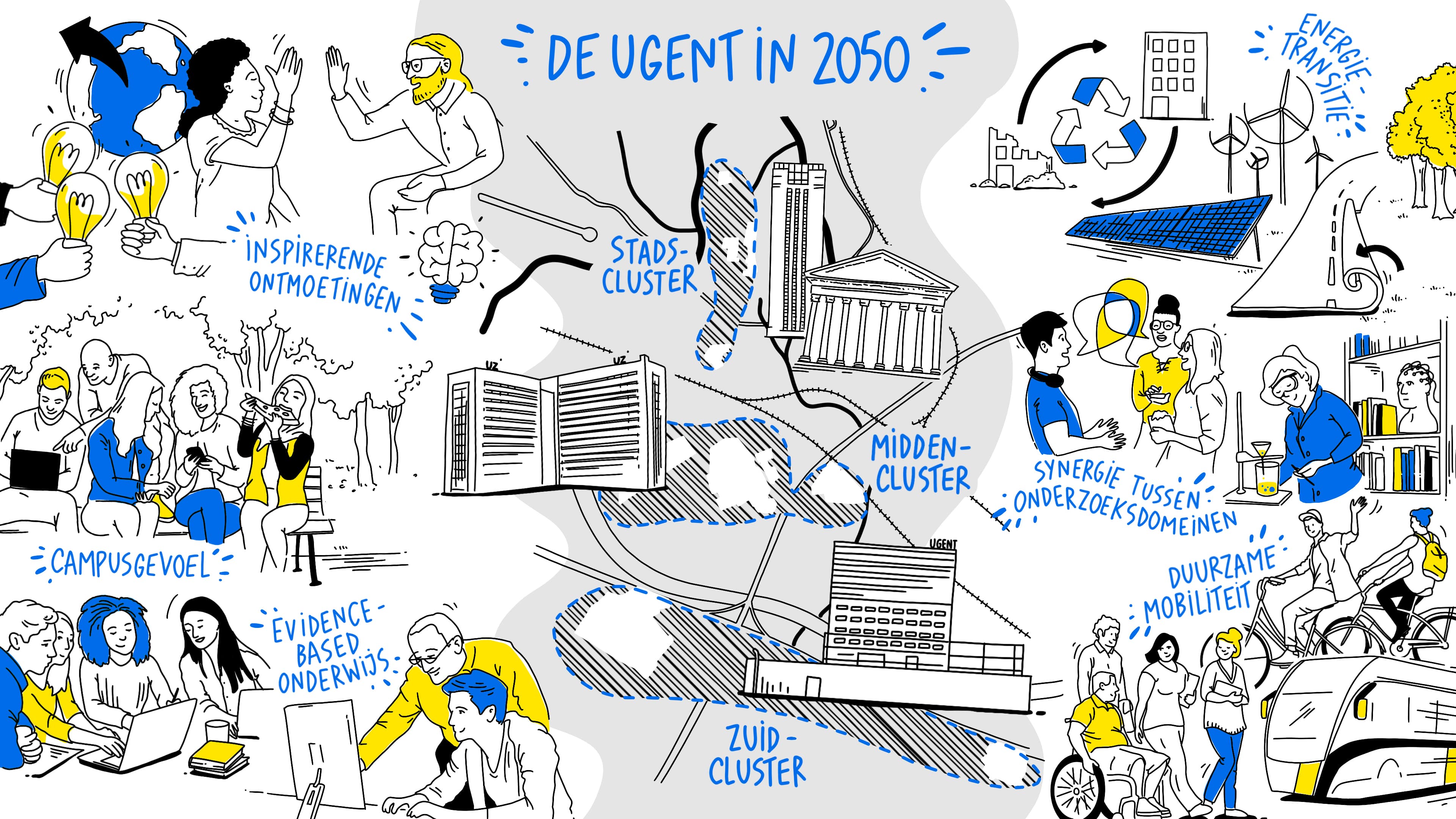
Education, research and services are Ghent University's core tasks. The challenges — and opportunities — are also great in the areas of sustainability, mobility and digitalisation. The plan allows the university to respond to these optimally. Ghent University places particular emphasis on shared facilities within the core campuses to realise a high-quality, sustainable and compact university.
Collaboration between researchers from different backgrounds and with diverse expertise leads to cutting-edge research. The three-cluster model, with open buildings and space for serendipitous encounters, should facilitate that kind of research. We wish to create even more shared research infrastructure and more synergy between research domains.
This vision will henceforth be central to every decision regarding Ghent University's estate. Every construction or renovation project will be assessed against it.